
Georgia Foreclosure Timeline: What Happens at Every Stage — And When You Must Act
Georgia is one of the fastest foreclosure states in the country.
Unlike states where foreclosure requires a judge and can take a year or more, Georgia uses a non-judicial process — meaning your lender can move from missed payment to auction without ever stepping foot in a courtroom. The entire process can unfold in as little as 60 days.
Understanding exactly what happens at each stage — and more importantly, what you can still do at each point — can be the difference between losing your home and finding a real way out.

Stage 1: Missed Payments (Days 1–30)
The clock starts the moment you miss a payment.
Most lenders don't act immediately. Many will attempt to contact you by phone, letter, or email during the first 30 days. You may also hear from a loss mitigation department — the lender's internal team specifically tasked with avoiding foreclosure, because foreclosure costs lenders money, too.
What you can still do at this stage:
Contact your lender directly to discuss a temporary forbearance or repayment plan
Begin the loan modification process
Reach out to a foreclosure specialist to understand all your options before pressure builds
The mistake most homeowners make here: Hoping it resolves itself. The first 30 days are the highest-leverage window you have.
Stage 2: Notice of Default / Breach Letter (Around Day 30–60)
If payments remain missed, your lender will typically send a formal Notice of Default — sometimes called a breach letter. This letter states that you are in default and gives you a specific number of days (usually 30) to cure the default before formal foreclosure proceedings begin.
This is not yet the foreclosure notice. It is the lender's last formal attempt to resolve the situation before escalating.
What you can still do at this stage:
Reinstate the loan by paying all overdue amounts, fees, and costs
Submit a loan modification application
Begin exploring a pre-foreclosure sale if reinstatement isn't feasible
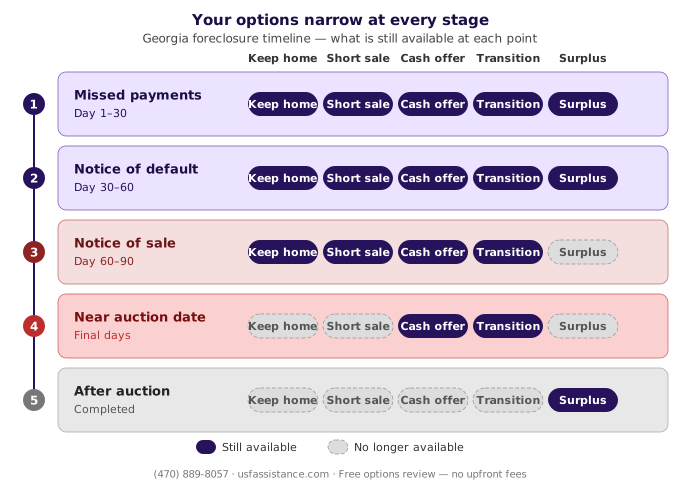
Call a foreclosure specialist — all 5 options are still on the table
Stage 3: Notice of Foreclosure Sale (Around Day 60–90)
If the default is not cured, your lender will publish a Notice of Foreclosure Sale in the local newspaper for four consecutive weeks before the scheduled auction date. They are also required to send this notice to you directly.
This is the formal start of the foreclosure process in Georgia. The auction date is now set — typically the first Tuesday of the month following the four-week notice period.
What you can still do at this stage:
Reinstate the loan (still possible up to 5 days before sale)
Negotiate a short sale or cash offer closing — time is tight, but not gone
Explore a cash-for-keys transition plan
Contact us immediately — don't wait
At this point, every day matters. Options that were available last month may no longer exist. The window is narrowing in real time.
Talk to a Georgia Foreclosure Specialist Today →
Stage 4: Foreclosure Auction (The First Tuesday of the Month)
Georgia foreclosure auctions are held on the first Tuesday of each month on the courthouse steps of the county where the property is located.
If the property reaches auction, it is sold to the highest bidder. In many cases, the lender bids the amount of the outstanding debt and takes the property back — this is called a bank-owned or REO (Real Estate Owned) property.
What happens to you after the auction:
You lose all equity in the property
The foreclosure appears on your credit report and stays there for 7 years
If the sale doesn't cover the full debt, the lender may pursue a deficiency judgment against you
You may face eviction proceedings
What you can still do after the auction: One option remains even after the sale: Surplus Fund Recovery. If the auction price exceeded the total amount you owed, the difference legally belongs to you — and you can still claim it.
Find Out If You're Owed Surplus Funds →
A Visual Summary: Your Options at Each Stage
The Most Important Thing to Know
In Georgia, there is no redemption period after the foreclosure sale. Once the auction completes and the deed transfers, it's over. There is no coming back.
This is fundamentally different from many other states, where homeowners have months after the auction to reclaim their property. In Georgia, the auction is the finish line.
Which means everything that matters happens before the auction.
Don't Wait Until the Next Stage
Every stage in this process closes a door. The homeowners who come to us and find the best outcomes are almost always the ones who reached out earlier than they thought they needed to.
If you've received any kind of notice — or you've simply missed a payment and you're worried — now is the time to understand what's still available to you.
Your options review is confidential, costs nothing upfront, and takes less than 60 seconds to start.
Get Your No-Obligation Options Review → Or call us directly: (470) 889-8057
US Foreclosure Assistance, LLC is a real estate services company, not a law firm, and does not provide legal advice.